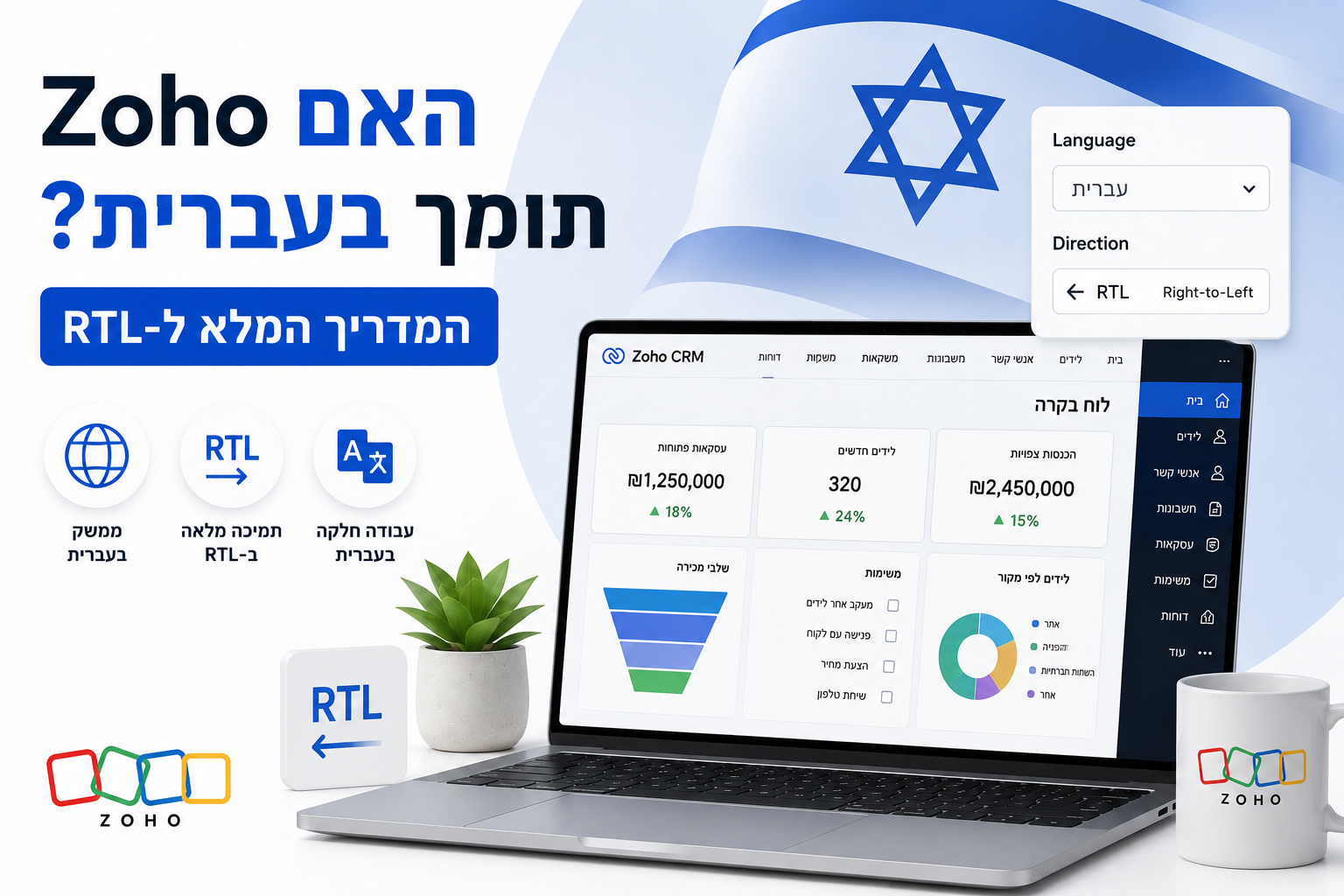
Hebrew support is the most important software question for most businesses in Israel, and most international SaaS providers fail in it. Either they offer a translation without RTL — which produces a broken and unusable interface — or they don't support Hebrew at all. Zoho is one of the few major platforms that truly support Hebrew: with a correct RTL layout, mature translations, and a public roadmap for deepening the investment. This guide covers exactly what works, what doesn't, and how to configure Hebrew throughout the package.
The short answer: Yes, Zoho really supports Hebrew
Hebrew is one of the 28+ languages officially supported in Zoho CRM, and similar coverage exists in most of the suite's main products. The word "really" here is important — Zoho doesn't just translate text. The interface itself is reversed when Hebrew is selected, so that the navigation flows from right to left, the sidebars move to the right side, and the visual hierarchy corresponds to the natural reading direction of Hebrew speakers. This is the difference between real RTL support and what most SaaS providers call "Hebrew support" but is actually just a text translation.
Why RTL is important (and why translation alone is not enough)
When a business application is translated into Hebrew without RTL, the result is an unusable interface for daily work. Imagine reading a sentence from right to left while the buttons, menus and form fields still flow from left to right. The eye is forced to jump. Forms ask to fill in fields in reverse order from the natural reading direction. Reports become confusing. A true RTL implementation changes the entire interface — the sidebar moves to the right, OK and Cancel buttons switch places, dropdown arrows are reversed, and the text alignment matches the reading direction. That's what Zoho delivers, and that's what most international competitors don't.
Which Zoho apps support full Hebrew + RTL
The following apps offer a comprehensive Hebrew translation and another real RTL interface where the layout is reversed. These are the applications that can be safely deployed to a Hebrew-speaking team.
- Zoho CRM — Hebrew full of leads, contacts, transactions, reports, dashboards and email templates. 28 languages supported in total.
- Zoho Mail — full RTL interface reversal since 2022. The entire email interface is reversed to Hebrew.
- Zoho Workplace — The productivity suite (Mail, Writer, Sheet, Show, Cliq, Meeting) supports RTL in most components.
- Zoho Sheet — RTL support for spreadsheets, including column order and formula row.
- Zoho Books — an accounting interface in Hebrew with invoices and RTL reports.
- Zoho Creator — RTL layout for custom apps. It is possible to build intra-organizational applications in Hebrew and the interface will change for the end users.
- Zoho SalesIQ — Hebrew RTL support was recently added. Both the operator's dashboard and the chat widget on the site support Hebrew.
- Zoho Forms — Hebrew support with RTL form layouts.
Zoho CRM in Hebrew: what to expect
Zoho CRM has the most mature implementation of Hebrew in the package. When Hebrew is activated at the organization or user level, the entire interface is reversed: the module bar moves to the right, dropdown menus open to the left, field labels are aligned to the right, and reports reverse their column order. Custom fields you create can be read in Hebrew, and will appear correctly on detail pages, list views, search results and exported reports. Pipeline stages, transaction owners, and contact records all display correct Hebrew text with correct two-way handling—including mixed content where a customer's name in Hebrew appears next to an English email address.
Zoho Mail in Hebrew: an unusual case
Zoho Mail's Hebrew support deserves special mention because it competes directly with Gmail and Outlook, both of which have a weaker Hebrew implementation. In 2022, Zoho Mail launched a full UI RTL flip across the entire Mailsuite, meaning the mailbox, compose window, settings panel, and calendar are all flipped for Hebrew users. There is no need to activate a separate RTL setting — choosing Hebrew as the display language automatically activates the reverse layout. For Israeli organizations switching from Gmail or Outlook to a cheaper email provider, this is one of the strong reasons to seriously examine Zoho Mail.
Zoho Books in Hebrew: critical to Israeli accounting flows
Zoho Books supports in Hebrew the entire flow of accounting — invoices, quotes, expenses, supplier records and reports. Invoices can be generated in Hebrew with a correct RTL layout, which is essential for Israeli businesses that send invoices to local customers. Israeli Shekel (ILS) is supported as a primary currency, and VAT treatment can be set for Israeli rates. One important caveat: reporting to the Israel Tax Authority (such as the standard CSV format required by the authority) usually requires integration through a partner and is not built directly into Zoho Books. Most Israeli implementations use a dedicated partner plugin or combine Zoho Books with a local Israeli accounting tool for the final tax submission.
How to enable Hebrew in Zoho
Hebrew activation is simple but is done on several levels. Can be set as a default for the entire organization, or per user. The typical flow:
- Enterprise Default — Set in Zoho Directory (Admin Console). All new users will receive the selected language by default.
- Change per user — each user can change the personal display language in the profile settings without affecting others.
- Exceptions per application — some applications (Mail, Workplace) inherit from the global Zoho account settings; Others need to be defined within each application.
- Browser refresh required — after changing the language, refreshing the page activates the RTL layout. The change is immediate after the refresh.
- Client-facing content — Hebrew interface for staff separate from Hebrew content sent to clients (e.g. email templates, invoice templates). They are defined separately in each application.
Known limitations and workarounds
Zoho's support in Hebrew is one of the best in business SaaS, but it is not perfect. Here are the rough edges you should know before deploying.
- Zoho Payroll is not adapted to Israel — most Israeli companies still connect Zoho One to Hilan or Michpal for actual payroll processing.
- Marketplace plugins vary — Third-party apps in Zoho Marketplace may or may not respect RTL. It is worth checking each add-on before adoption.
- HTML Email Templates — Custom HTML templates specifically need a dir="rtl" attribute and right-align styles. Default templates handle this automatically.
- Part of the help documentation in the Zoho Help Center is in English only — the Hebrew product interface is mature, but support documents in Hebrew are still being expanded.
- Bidirectional text in reports — most reports handle mixed Hebrew + English content well, but long mixed language strings can sometimes look unexpected. Visual inspection of complex reports is recommended.
Hebrew support: Zoho versus the competitors
Hebrew and RTL support is the area where Zoho stands out most clearly over international competitors. Here's what it looks like.
| platform | Hebrew text | Real RTL layout | Invoices/forms in Hebrew | mainly suitable for |
|---|---|---|---|---|
| Zoho | ✅ Full | ✅ Full reversal | ✅ Yes | Israeli businesses that need native Hebrew |
| Salesforce | ✅ Translated | ⚠️ partial | ⚠️ Requires adjustment | Global organizations whose main language is English |
| HubSpot (Pro) | ⚠️ Limited translation | ❌ No | ❌ No | Marketing organizations that operate in English |
| HubSpot Free | ❌ No | ❌ No | ❌ No | Not recommended for Hebrew speaking teams |
| Pipedrive | ❌ No | ❌ No | ❌ No | Not recommended for Hebrew speaking teams |
| Microsoft Dynamics 365 | ✅ Translated | ⚠️ partial | ✅ Yes | Organizations on the Microsoft stack |
| Priority Software | ✅ Native | ✅ Native | ✅ Native | ERP-based Israeli organizations |
Best Practices for Israeli teams who deploy Zoho in Hebrew
After dozens of Zoho implementations in Hebrew, these are the patterns that consistently produce good results.
- Set Hebrew as the corporate default — don't force each user to switch on their own. This ensures that new employees receive Hebrew automatically.
- Use Hebrew for module and field names — even if Zoho allows you to mix fields in English with a Hebrew interface, naming the fields in Hebrew matches the users' expectations and prevents cognitive friction.
- We standardized templates that address customers in Hebrew first - invoices, quotes, email signatures. English versions can be added as alternatives.
- Test third-party integrations carefully — anything from Zoho Marketplace, custom Deluge code, or external webhook integrations should be tested for RTL behavior before go-live.
- We trained new users in the Hebrew interface - even if they are comfortable in English, training in the language in which they will work on a daily basis produces faster adoption.
- Do not mix languages within the text of a single record — Hebrew + English in the same description field are supported, but stylistically it is better to keep a record in one primary language with optional translated alternatives.
Looking ahead in 2026: Zoho's investment in Hebrew is increasing
With the announcement of the opening of the office in Tel Aviv in December 2025, Zoho publicly committed to continuing translation work and deepening the investment in the Hebrew interface. The company specifically stated "a deeper Hebrew interface and technical support" as priorities for the new local office, along with a stronger local partner system. For businesses that are now considering between Zoho and alternatives, this route is significant: the rough edges in Hebrew that exist today are being actively addressed, while most international competitors do not invest in the Israeli market in a similar way.
Conclusion
Zoho offers the deepest Hebrew and RTL support among major international business platforms, and this gap is expected to grow as Zoho continues to invest in the Israeli market through the new office in Tel Aviv. For Israeli teams, it's not just a question of translation - it directly affects daily productivity, professionalism with clients, and how natural the work in the system is. The 1T Solutions team implements Zoho in Hebrew for businesses in Israel at a fixed price, including translation of custom fields, email templates in Hebrew and invoice design in Hebrew. Contact us for a free characterization call.